The Red Barn, by GEL Architects
When architect Tim Daniel of Gel Architects and his partner, Sarah James, stumbled across a retired piece of farmland with pockets of regenerating native bush, located close to Mangawhai, they saw it as their opportunity to design a property entirely for themselves.
The pair collaborated on the design, primarily in the evenings after a day’s work.They wanted a building with a minimal footprint that would blend into the 1.3-hectare site, rather than standing out, so the new home was designed to sit low among regenerating native bush and disused paddocks.
“We wanted something small and simple and multipurpose; we wanted to show it’s possible to do a small house well, without compromising or having spaces that need to be adapted and converted for different purposes every time you want to use them,” says Tim.
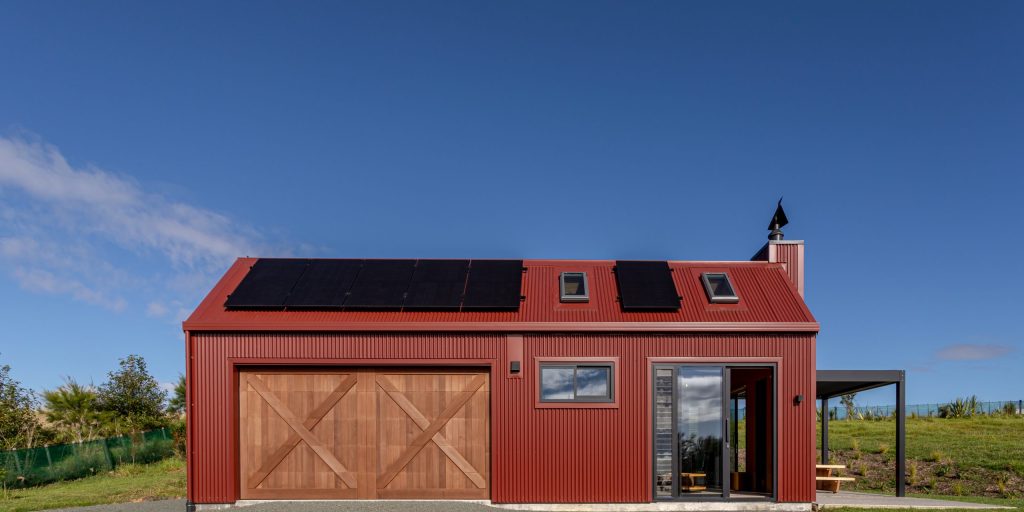
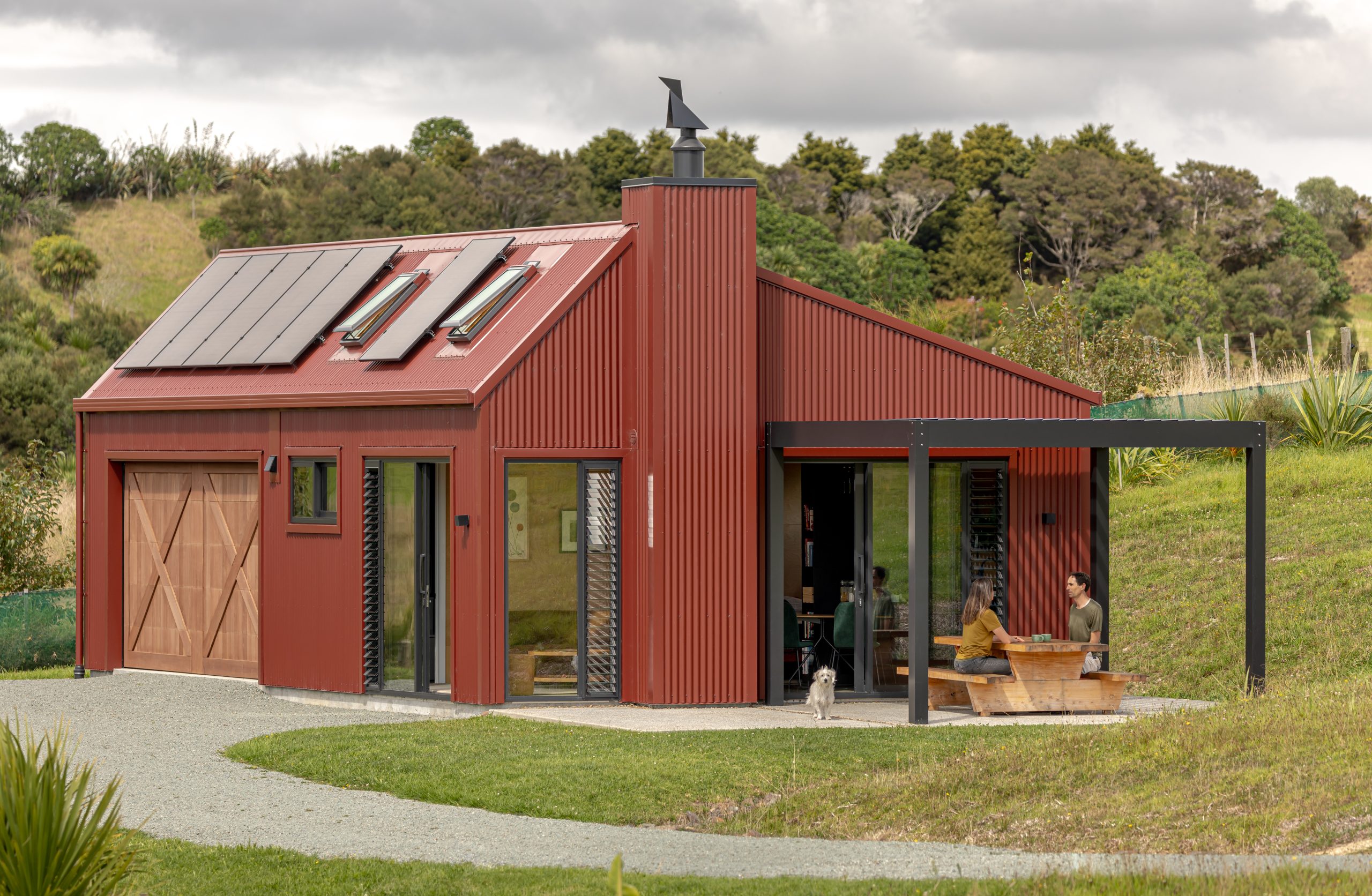
And while it is compact, the house offers all the features Tim and Sarah wanted to create a comfortable holiday home. It has a footprint of 36 square metres, with a bedroom, bathroom, kitchen and living area on ground level, although a nearby space, originally designed as a garage, now functions as a home office, studio and workshop. Upstairs, above the main house, is a six-square-metre sleeping loft for visitors, and a pergola extending from the living area creates additional space in an outdoor room.
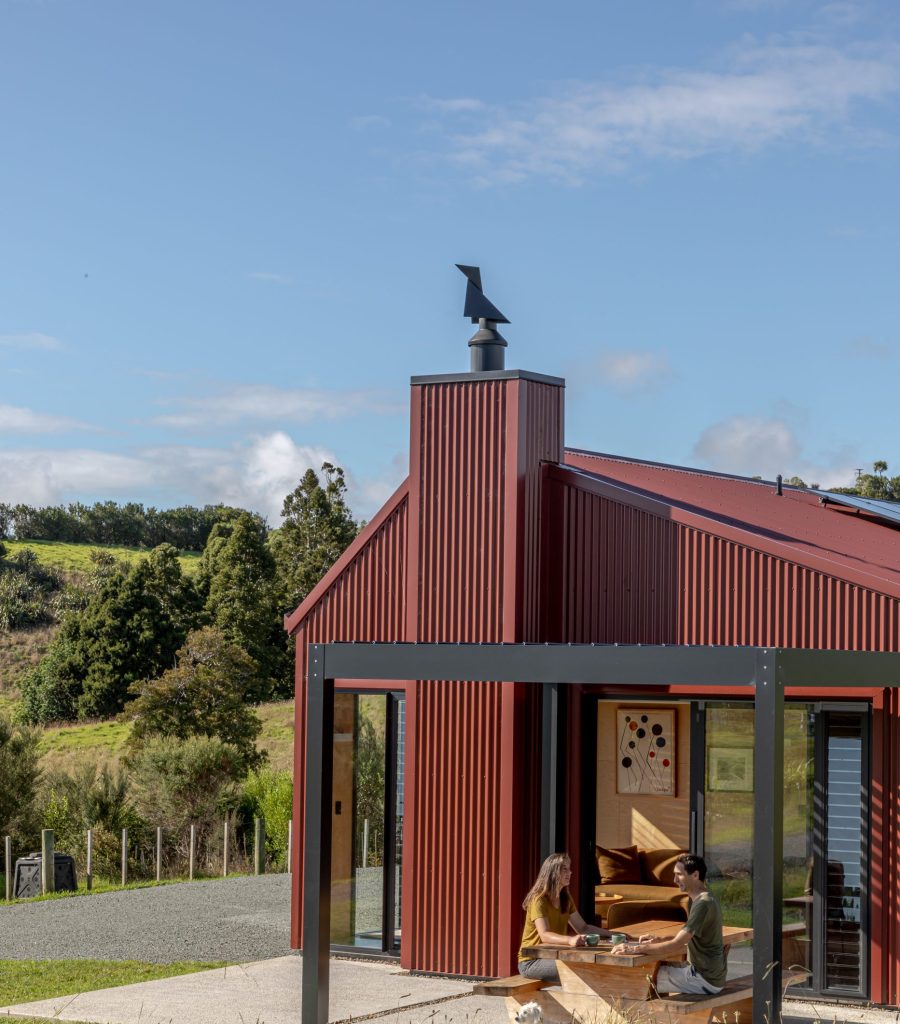
The building design features an asymmetrical gabled shape that reflects Christchurch-born Tim’s memories of the historical settlers’ homes and goldminers’ cottages of central Otago, with their simple forms, corrugated iron cladding and chimneys jutting out from one end of the building. The farm shed-style design also harks back to the traditional red barn forms of Madison County, in Iowa, where Sarah’s father lived.
To achieve the desired look, Tim specified Scoria-Red 0.55 gauge corrugate, with its rustic and rural appearance, for both the exterior walls and roof of the home.
“The metal cladding is low maintenance and well-priced; it’s a simple material that is robust and easy to look after. Plus, it’s made in NZ, and it’s nice to know that at the end of its life it is recyclable,” Tim says.
Roofing contractor Simon Carter of Carter Roofing, in Mangawhai, says the design of the roof itself, with its steep double pitch and barge flashings at each end, made from .55 gauge corrugate with a ColorCote® ZinaCore finish, was reasonably straightforward. The solar panels were added after the roof was completed.
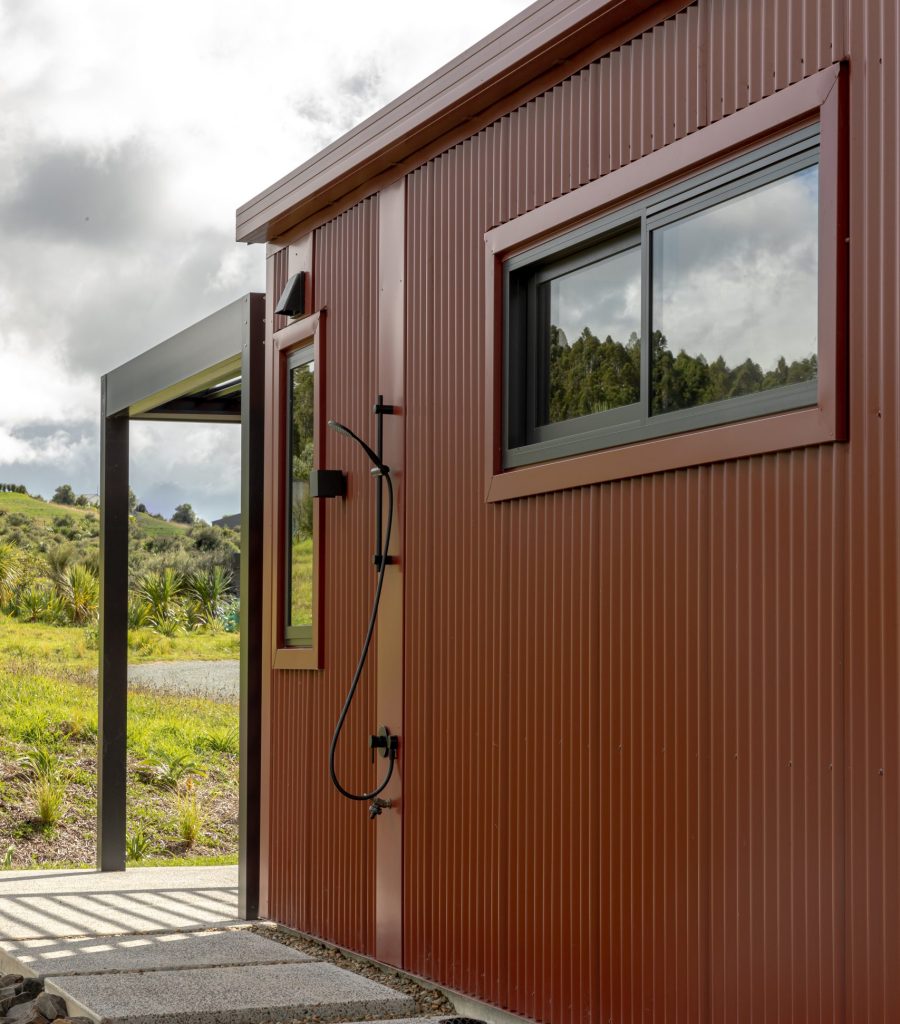
However, the bigger challenge of the project was to realise the architect’s brief to create evenly spaced negative details on either side of the windows and chimney. To achieve this, the windows were recessed, allowing the flashings to stand proud of the glazing on the side and top edges.
“To create even flashings that lined up exactly from top to bottom on either side of the windows, we needed to work closely with the builder, Nick Smith of Smith Construction, to ensure the windows were dead straight and plumb when they were installed. It was very intricate and exacting work – both for the builder and for us,” he says.
The flashings had to appear as symmetrical as possible on the sides of both the chimney and the windows. Simon says that to achieve the required level of accuracy, his team set out the sheets of corrugate in advance of installing them to make sure the negative details would be as even as possible. If the detailing had been wrong, the builder would have had to remove and reinstall the windows.
“The 0.55 gauge corrugate is a lot stiffer and harder to tweak into place to get it straight than, for example, timber cladding. It’s much more difficult to work with this particular material to achieve the degree of accuracy that the architect was looking for. However, we got there, and the result is great,” says Simon.
Carter Roofing fitted gutters onto custom-made flashings, where accuracy was again essential. So, to ensure the flashings were folded exactly as required, Simon supplied the manufacturer with working drawings.
For this project, the architect specified a corrugated profile, which is a classic-style metal roofing material finished with a ColorCote ZinaCore, a durable, corrosion-resistant aluminium/zinc alloy core with a baked-on acrylic or polyester top coat. The combination of the classic corrugate profile and the ZinaCore finish creates a roofing material that is well-suited to a wide range of architectural styles and can be used for both roofing and cladding applications.
To complete the interior, Tim and Sarah have chosen natural, sustainable local materials throughout, with every detail carefully considered to maximise the potential of the whole space.
The house is entirely off-grid, powered by rooftop solar panels and a battery bank. The photovoltaic panels on the roof generate nearly 8 MWh a year, stored in a bank of lithium batteries. It also features an efficient hot-water heat pump, energy-conscious appliances, and a wood fire for heating on cold winter days and evenings. Waste water is processed on site using a worm-based system that mimics a forest floor, and rainwater is collected and stored in underground tanks.
This case study was written by and featured in SCOPE Magazine Issue 63.
| ColorCote Product | ZinaCore |
| Profile | Corrugate |
| Architect | Tim Daniel, GEL Architects |
| Installer | Simon Carter, Carter Roofing |
| Colour | Scoria |
| Photographer | John Williams, Create Content |
| Rollformers | Roofing Industries |